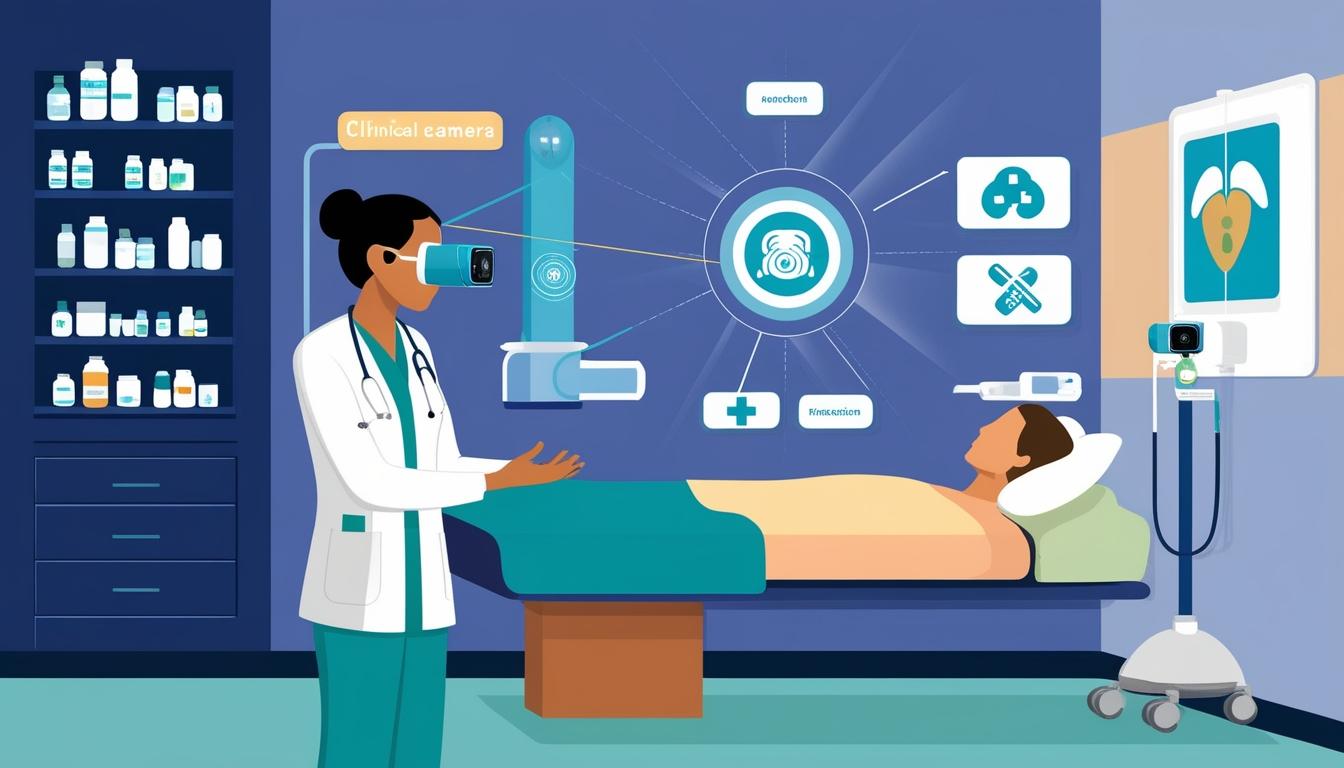
Researchers have developed an innovative wearable camera system incorporating artificial intelligence (AI) capable of detecting potential medication delivery errors. This ground-breaking technology, described in a study published on October 22 in npj Digital Medicine, demonstrates significant proficiency in recognising medication-related inaccuracies in demanding clinical environments.
The study highlights that this video system attained a sensitivity of 99.6% and a specificity of 98.8% in detecting vial-swap errors. The system is envisioned to function as a crucial safety measure in high-stakes healthcare settings like operating rooms, intensive care units, and emergency departments. Dr. Kelly Michaelsen, co-lead author and assistant professor of anesthesiology and pain medicine at the University of Washington School of Medicine, expressed optimism about the potential to avert medication errors, stating that achieving near-perfect accuracy, which even human practitioners find challenging, is of substantial value.
Medication errors are notably prevalent as critical incidents in anaesthesia and constitute significant medical errors in intensive care. A broader perspective reveals that 5% to 10% of administered drugs are associated with errors, with adverse events from injectable medications impacting approximately 1.2 million patients annually, contributing to costs estimated at $5.1 billion.
Syringe and vial-swap mistakes frequently arise during intravenous injections, where clinicians must accurately transfer medication from the vial to the syringe before administering it to patients. About 20% of these errors are substitution errors, involving incorrect vial selection or syringe mislabelling, while another 20% arise from correctly labelled but inappropriately administered drugs.
Existing safety protocols include barcode systems to verify vial contents, though these are sometimes overlooked in high-pressure situations due to their additional procedural requirements. The new AI-driven system aims to mitigate these errors by employing a deep-learning model paired with a GoPro camera to identify medication contents from their physical characteristics, such as vial and syringe shape, size, and cap colour, without relying on textual labels which can often be obscured by healthcare providers’ hands during swift movements in clinical procedures.
Training this sophisticated computational model required months of effort. Researchers captured 4K video footage of 418 drug draws performed by 13 anaesthesiology providers across varying setups and lighting conditions in operating rooms. This footage was used to train the AI system to accurately recognise different medications based on visual cues.
Professor Shyam Gollakota from the University of Washington’s Paul G. Allen School of Computer Science & Engineering, a co-author of the study, noted the complexity of the task due to the quick-moving nature of clinicians who are not positioning medications for optimal camera view. The AI was additionally programmed to concentrate on the medications being actively handled in the foreground, while disregarding those idle in the background.
This pioneering research included contributions from Carnegie Mellon University and Makerere University in Uganda, and the system’s development was supported by the Toyota Research Institute. Financial backing came from the Washington Research Foundation, the Foundation for Anesthesia Education and Research, and a National Institutes of Health grant. The authors have disclosed any potential conflicts of interest, which can be accessed upon request.
The technology's potential extends to enhancing safety and efficacy within various healthcare practices, with researchers poised to further explore its applications. Video evidence illustrating the AI’s capability to detect errors in real time has been made available by the Paul G. Allen School of Computer Science & Engineering.
Source: Noah Wire Services