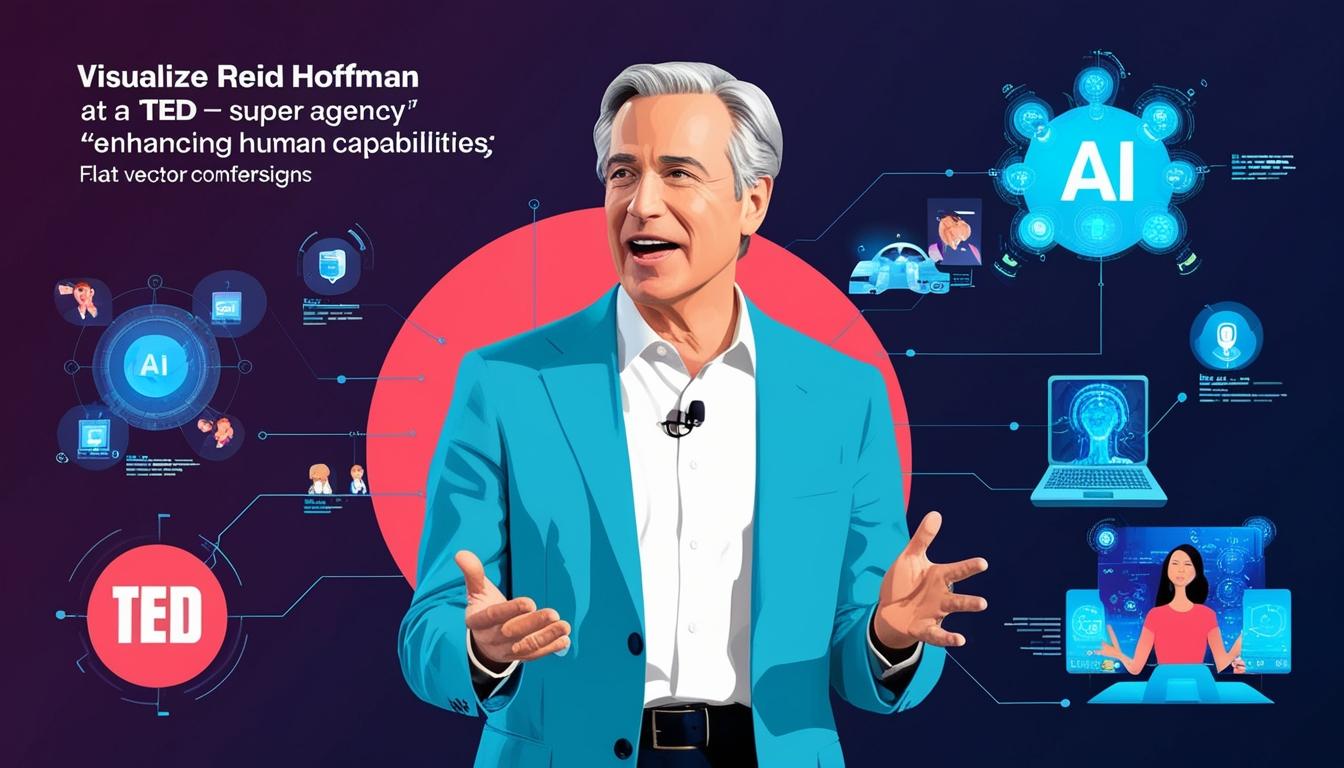
Reid Hoffman, the co-founder of LinkedIn and a well-known technology investor, recently outlined his positive perspective on artificial intelligence at a TED AI conference held in San Francisco. During a conversation with CNBC’s Julia Boorstin, Hoffman introduced his concept of "super agency," which frames AI as a means of enhancing human capabilities rather than replacing them. This idea is explored further in his forthcoming book, where he argues that AI should be embraced as the next major advancement in human potential.
Hoffman likened the impact of historical technological innovations, such as the invention of automobiles, to the potential of AI. He described AI systems as providing "cognitive superpowers." His discussion comes at a critical time as public concern grows about AI’s potential to displace jobs and influence democratic processes through misinformation.
Addressing election integrity, Hoffman acknowledged looming challenges but suggested that the risks posed by AI-generated deepfakes in elections, particularly the 2024 US presidential race, are currently negligible. However, he did stress the importance of developing technical safeguards such as encryption timestamps to verify content authenticity.
In defense of Governor Gavin Newsom’s decision to veto comprehensive AI regulation in California, Hoffman expressed support for the strategy adopted by the White House, which encourages voluntary compliance from technology companies before codifying specific regulations. He warned that imposing ambiguous penalties might stifle technological innovation by fostering uncertainty.
As for the role of startups in the evolving AI landscape, Hoffman emphasized that despite the dominance of tech giants in developing foundational AI models, startups have abundant opportunities to innovate, particularly in fields like sales, marketing, and cybersecurity. He envisages a future where AI significantly democratizes access to expertise, offering essential services universally through digital means.
The discussion also underscored the political divisions emerging within Silicon Valley regarding AI policy. Hoffman indirectly critiqued tech leaders who have shown support for former President Donald Trump, implying that such alliances may be motivated by financial gains like securing government contracts, rather than genuine policy ideals. This was perceived as a subtle jab at Elon Musk, who has publicly supported Trump.
Hoffman, a known Democratic patron, particularly backing figures such as Vice President Kamala Harris, suggested that part of Silicon Valley's rightward shift might be attributed to single-issue voters, particularly those with interests in cryptocurrency or business executives seeking beneficial regulations. He reiterated that a stable business environment conducive to long-term investment is crucial, overshadowing more narrow, business-friendly legislative changes.
In summarising his view of the future workforce, Hoffman suggested that AI represents a shift not towards obsolescence but towards empowerment. He argued that the essence of the future lies not in the dichotomy between humans and machines but in the disparity between those who adopt AI tools and those who do not. His message underscores that, as AI continues to develop, its real potential lies in augmenting human capabilities, challenging traditional perceptions of work in an increasingly AI-centric world.
Source: Noah Wire Services