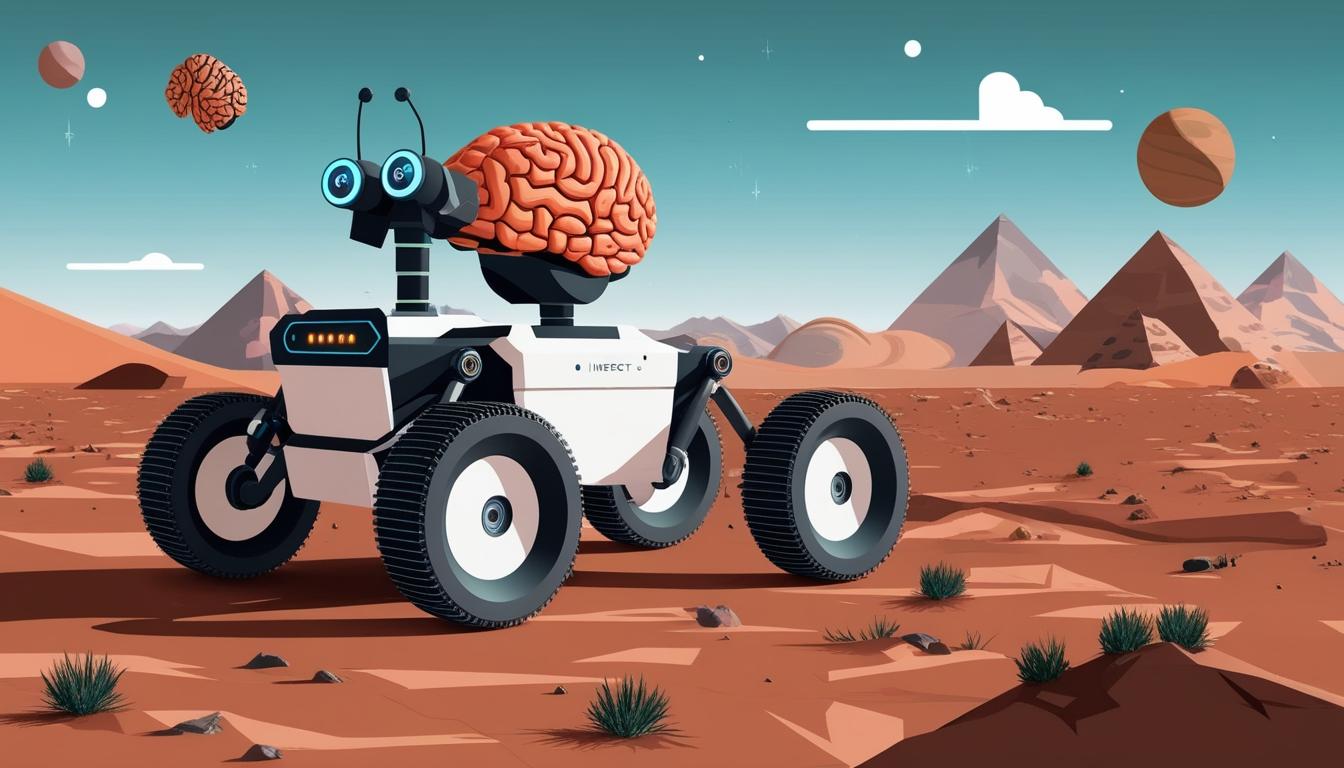
A new breakthrough in artificial intelligence (AI) technology is on the horizon, with the potential to redefine the capabilities of robots used in space exploration. A collaboration between British startup Opteran, the University of Sheffield, Airbus, and the UK and European Space Agencies aims to harness insect brain algorithms to power robots designed for Mars exploration.
Opteran, a company specialising in bio-inspired AI, has embarked on an ambitious project to leverage biological brain mechanisms. The approach involves 'reverse-engineering' insect brains to develop a neuromorphic software that enables machines to navigate complex terrains autonomously. The startup is working with 45 experts in the field to bring this innovative idea to reality.
David Rajan, the chief executive of Opteran, explained the premise of the project: “We’re harnessing 600 million years of evolution to create something we call neuromorphic software for machines. It’s a radical new scientific approach to doing AI.” This method diverges from traditional AI approaches, which heavily rely on processing and analysing vast amounts of data.
The inspiration for this novel AI software draws from the natural world. Insects, such as bees, ants, and flies, possess highly efficient navigational skills, despite having far fewer neurons than humans. A honeybee's brain, for instance, contains around one million neurons, yet it can perform intricate tasks and navigate effectively. This efficiency in decision-making and navigation has been the focal point of extensive research by scientists.
Last year, an experiment conducted by the University of Sheffield, in conjunction with Macquarie University in Sydney, shed light on the underlying mechanisms driving the impressive cognitive capabilities of these small creatures. Dr MaBouDi, from Sheffield's Department of Computer Science, stated, “We can now use these mechanisms to design better, more robust, and risk-averse robots and autonomous machines.”
The research findings support the notion that robotic systems can be enhanced by mimicking the cognitive processes found in insect brains. This could yield significant advancements in developing rovers capable of exploring the challenging Martian landscape. Such technology could offer improved resilience and adaptability, reducing the need for extensive pre-programmed data and training.
Airbus and the UK and European Space Agencies are key partners in this endeavour. Their involvement underscores the potential impact and importance of this development in the realm of space exploration. If successful, this innovative AI system could pave the way for a new generation of Martian rovers, efficiently navigating the Red Planet using centuries-old evolutionary solutions replicated through advanced technology.
As this project progresses, it stands to transform not only our understanding of artificial intelligence but also our approach to space exploration, potentially leading to more cost-effective and reliable robotic missions beyond Earth.
Source: Noah Wire Services