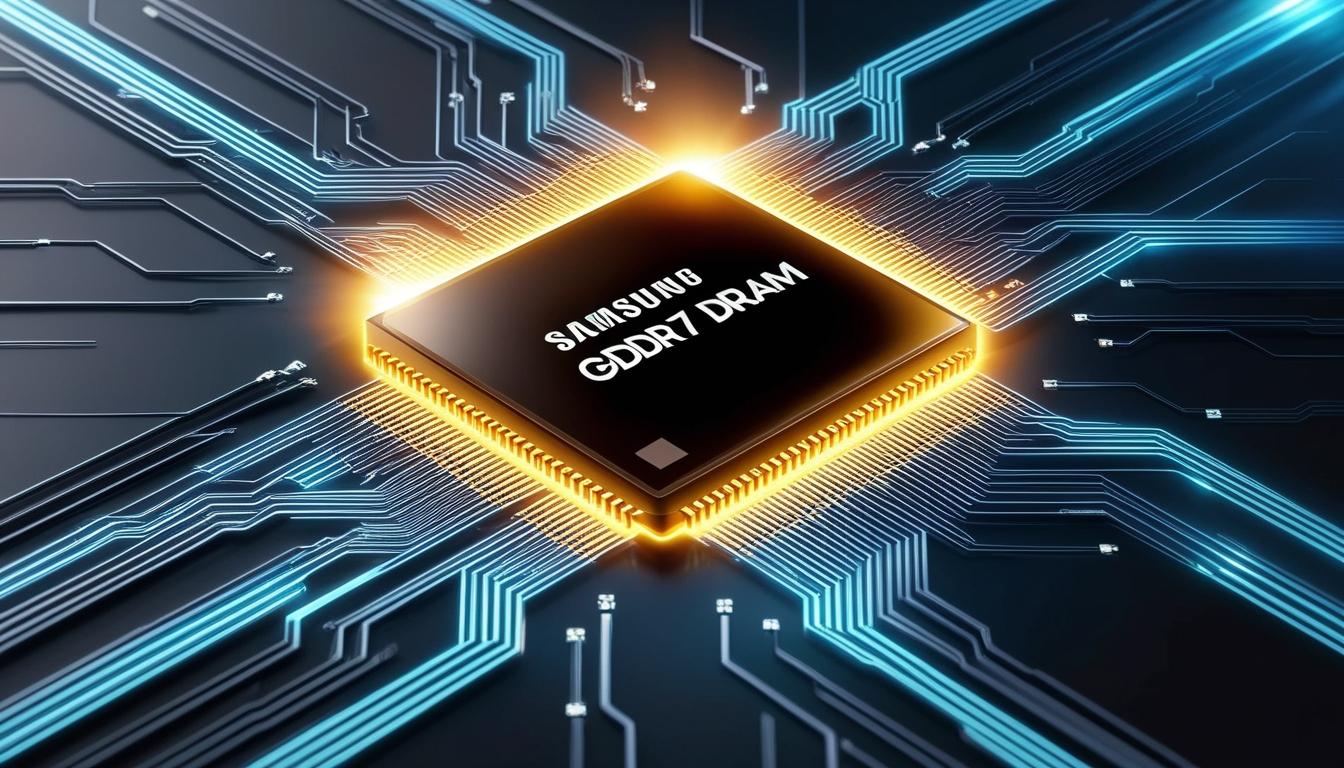
Samsung Electronics has announced a significant breakthrough in the field of memory technology with the development of the industry's first 24-gigabit (Gb) graphics double data rate 7 (GDDR7) dynamic random-access memory (DRAM). This latest advancement is engineered to support the demanding needs of high-performance memory applications commonly utilised in data centres and artificial intelligence (AI) workstations. The introduction of this next-generation graphics DRAM marks a departure from its traditional uses in graphics cards, gaming consoles, and autonomous vehicle systems, offering a broader scope of application.
The 24-Gb GDDR7 DRAM from Samsung presents improvements across several critical areas, including capacity, speed, power efficiency, and cell density. The new memory boasts a speed of over 40 Gigabits per second (Gbits/s), representing a 25% increase over the previous GDDR6 iteration it succeeds. Additionally, the performance can further be enhanced to reach speeds of up to 42.5 Gbits/s, depending on specific use cases and environments. This remarkable performance is achieved through the utilisation of three-level pulse-amplitude modulation (PAM3) signalling, which facilitates these high speeds.
Innovations in power efficiency have also been a focal point in the development of the GDDR7 DRAM. Samsung reports a reduction in power consumption by 30%, which signals a significant improvement in power efficiency. This is achieved through the implementation of Samsung’s 5th-generation 10-nanometer-class DRAM technology, which permits a 50% increase in cell density whilst retaining the same physical package dimensions as its predecessor.
The power efficiency advancements derive from Samsung leveraging techniques previously applied in the manufacturing of graphics DRAMs for mobile products. Among these techniques is clock control management, which fine-tunes the timing signals of memory chips. Furthermore, the dual VDD design employed allows for different voltage levels to be supplied within a single chip, optimising power distribution. Enhanced operational stability is achieved via power-gating design techniques, effectively minimising current leakage.
Looking towards the future, Samsung plans to commence GPU customer validation on next-generation AI computing systems within the current year. This validation phase is a precursor to commercialisation, which is expected to roll out by early 2025. This timeline underscores Samsung’s commitment to advancing memory technology and meeting the evolving demands of the industry.
As Samsung moves forward with these innovations, the technological landscape for high-performance memory solutions is poised for transformation, with implications across various sectors reliant on advanced computational capabilities.
Source: Noah Wire Services