Artificial Intelligence Takes a Leap: Understanding Optical Illusions
Artificial intelligence has reached a groundbreaking milestone: the ability to perceive optical illusions in a manner akin to human interpretation. This advancement, reported by Ivan Maksymov, a researcher at Charles Sturt University in Australia, signifies a remarkable shift in the capabilities of AI, blurring the lines that once distinctly separated human cognition from machine processing.
Maksymov's study, published in APL Machine Learning, introduces an innovative AI system known as the "quantum-tunneling deep neural network." This system integrates quantum tunneling—a quantum physics phenomenon where subatomic particles, such as electrons, pass through seemingly impenetrable barriers—with deep neural networks, which are complex algorithms inspired by the human brain's neural pathways.
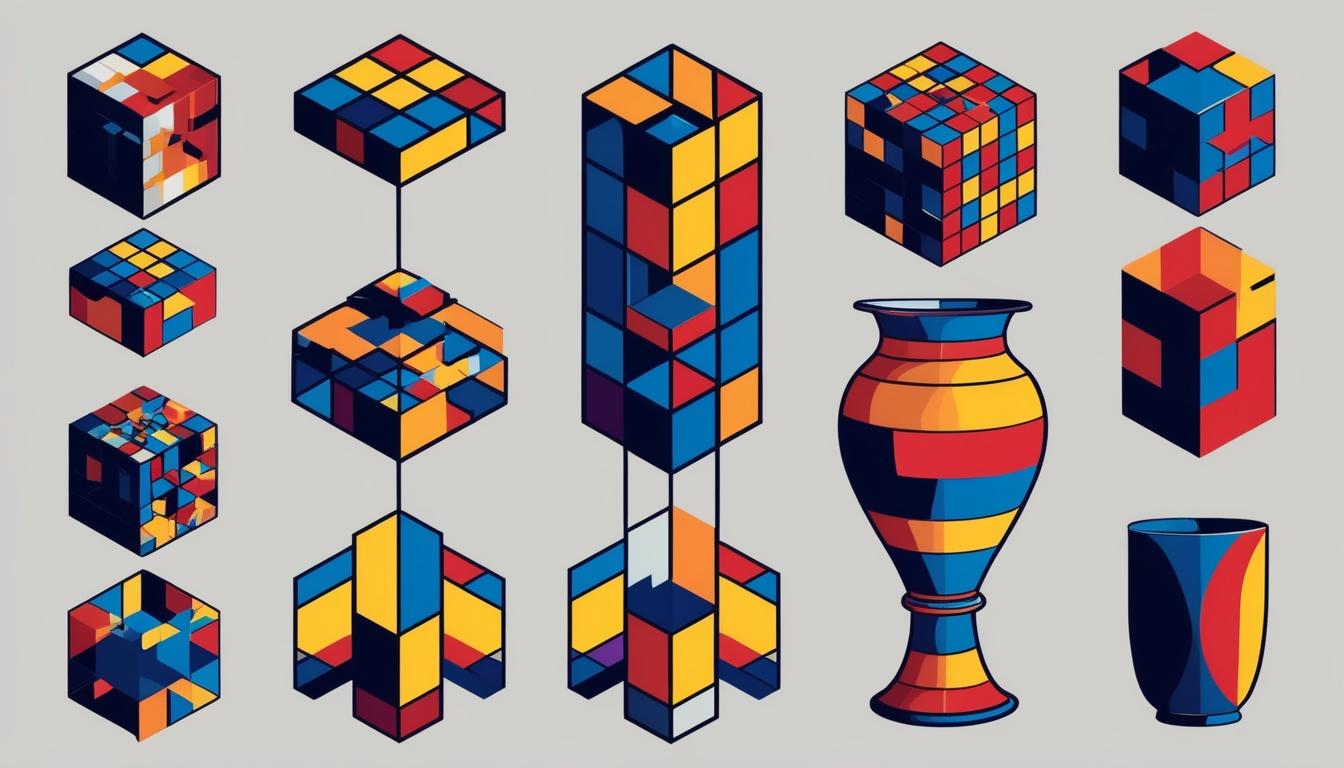
To achieve this human-like perception, the AI was trained using two classic optical illusions: the Necker Cube, which presents a three-dimensional cube that changes perspective, and Rubin’s Vase, an image that can be interpreted as either two faces or a vase. As the AI processed these illusions, it mimicked the human brain's process of switching between perspectives, effectively understanding the dual interpretations inherent in optical illusions.
Quantum tunneling plays a pivotal role in this breakthrough. In quantum physics, particles such as electrons do not have a fixed position when not observed directly. They behave as waves, allowing the possibility of them being on the other side of a barrier—a process leveraged by the AI to reinterpret visual stimuli.
Maksymov likens the process to the famous quantum mechanics thought experiment, Schrödinger's cat, where a scenario holds multiple potential outcomes simultaneously until an observation is made.
This AI capability may have practical applications beyond visual psychology. Maksymov suggests that the technology could unfold new methods for recognising disorientation and interpreting flight instruments—a significant benefit for pilots and astronauts. Furthermore, the same principles might aid in early detection of cognitive impairments and dementia by identifying changes in perception and pattern recognition in individuals.
This development aligns with a broader trend of AI advancements in creative fields. Recently, autonomous AI-generated artworks have been sold at prestigious venues like Sotheby's, and institutions such as London's V&A Museum have showcased AI art driven by human brainwaves.
As AI continues to evolve, its integration into sophisticated cognitive tasks traditionally reserved for humans points towards a future where the boundaries of artificial and human intelligence may become increasingly intertwined.
Source: Noah Wire Services