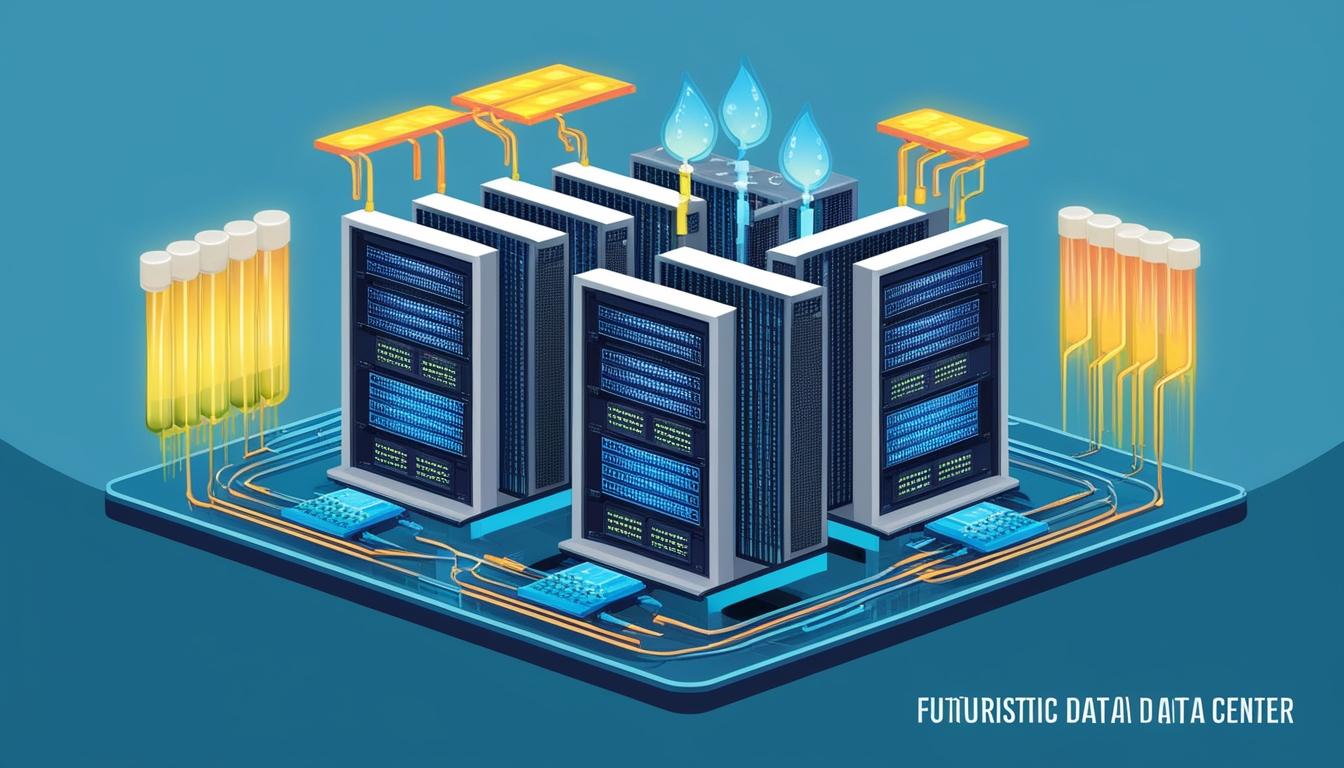
The growing demand for artificial intelligence (AI) technologies is transforming data centre operations around the world, prompting a significant shift towards more sophisticated cooling strategies. In response to the increasing volume of data and the resultant high-density computing requirements, tech companies are actively investing in innovative cooling techniques to ensure sustainable and efficient data management.
As major tech companies expand their infrastructure to support AI's demanding workloads, they're encountering the critical challenge of powering these operations affordably and sustainably. This necessity has led industry leaders such as Oracle and Microsoft to consider nuclear energy as a viable long-term power solution for their expansive data centres.
A parallel issue that has emerged is the need to effectively dissipate the heat generated by high-performance AI hardware. To address this, various tech firms are pioneering in liquid cooling systems—an advancement that enables continued optimal system performance while also accommodating the surging energy demands. Throughout October 2024, several companies introduced new liquid-cooled solutions, underscoring an industry-wide pivot to this cooling method.
Among the notable advancements in this field, Lenovo recently unveiled its latest Neptune liquid cooling solution at the Lenovo Tech World event. The sixth iteration of Neptune employs open-loop, direct warm-water cooling methodologies. This new system is being integrated across Lenovo's partner networks, facilitating the creation and operation of accelerated computing environments specific to generative AI, while reportedly reducing data centre power consumption by as much as 40%.
Meanwhile, at the OCP Global Summit 2024, Giga Computing, a subsidiary of Gigabyte, launched a direct liquid cooling (DLC) server, tailored for Nvidia HGX H200 systems. As part of their offerings, Giga introduced the G593-SD1, featuring a dedicated air cooling chamber for Nvidia’s H200 Tensor Core GPU, catering to data centres that have not yet fully transitioned to liquid cooling systems.
Dell Technologies has also embraced the shift towards liquid cooling with the introduction of its Integrated Rack 7000 (IR7000). This scalable system is engineered to handle liquid cooling setups for future deployments reaching up to 480 KW, efficiently capturing almost all the heat generated.
Arthur Lewis, president of Dell’s Infrastructure Solutions Group, remarked on the transformative nature of these systems, stating, "Today’s data centres can’t keep up with the demands of AI, requiring high-density compute and liquid cooling innovations with modular, flexible, and efficient designs. These new systems deliver the performance needed for organisations to remain competitive in the fast-evolving AI landscape."
Supermicro, another key player in this domain, has announced its liquid-cooled SuperClusters, powered by the Nvidia Blackwell platform. These SuperClusters, supported by the Nvidia GB200 NVL72 platform, are tailored for exascale computing and have begun sampling with selected customers. Full-scale production is anticipated by late Q4 of 2024. Charles Liang, president and CEO of Supermicro, reported significant uptake of these systems, noting over 2,000 liquid-cooled racks delivered since June 2024.
The liquid-cooled SuperClusters from Supermicro feature advanced coolant distribution units (CDUs) and custom cold plates, engineered to house two Nvidia GB200 Grace Blackwell Superchips within a 1U form factor, underscoring their commitment to innovative and sustainable AI computing solutions.
With these technological advancements, the integration of liquid cooling is poised to play a central role in future data centre operations as AI workloads continue to escalate. This technology will be crucial in managing the inherent challenges related to heat and energy consumption, setting the stage for improved efficiency, scalability, and sustainability in data centre management practices worldwide.
Source: Noah Wire Services