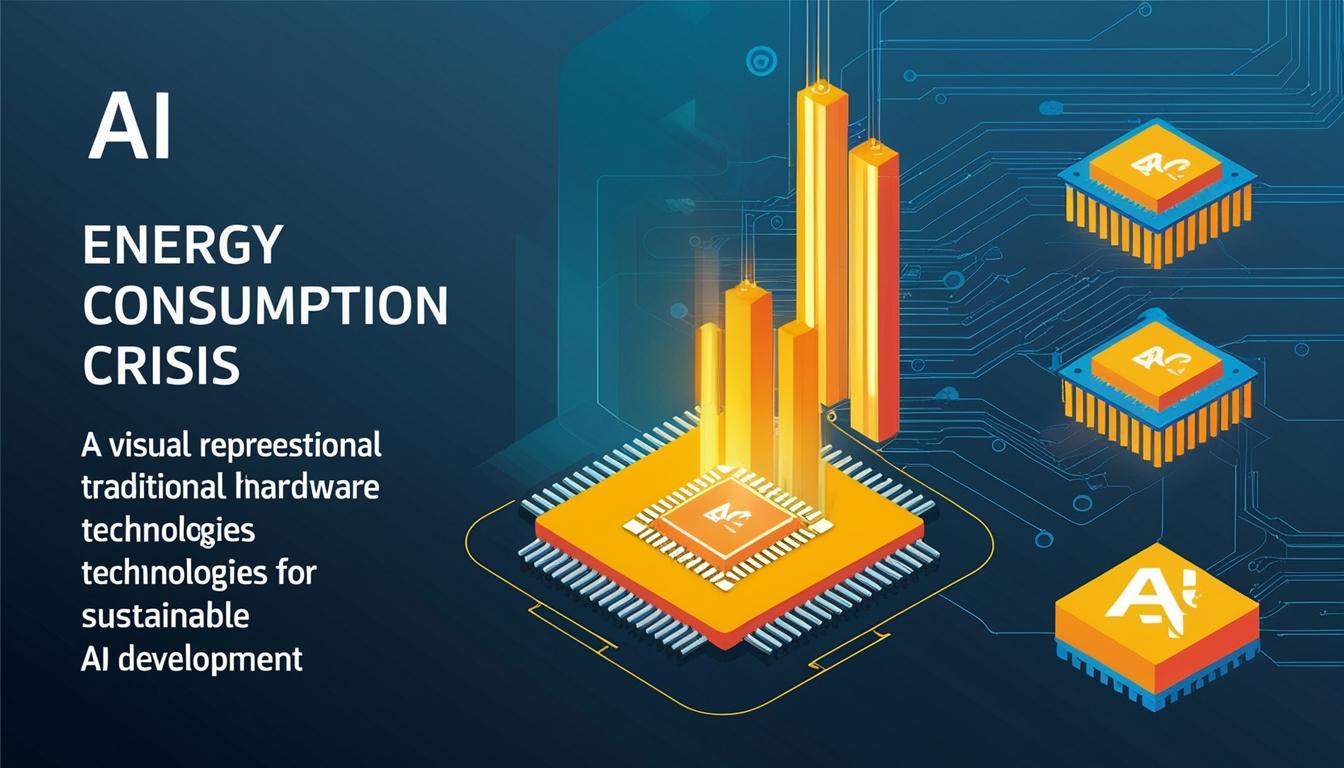
The rapid development of artificial intelligence (AI) technologies presents a significant challenge with respect to energy consumption, raising concerns about sustainability and efficiency. As technological advances continue to accelerate, the energy demands necessary to support AI are projected to surpass global energy production by 2035 if current hardware constraints remain unchanged. This prediction is prompting a reassessment of computing ecosystems, with an urgent push towards innovative hardware technologies.
At the heart of the issue lies the traditional von Neumann architecture that has underpinned computer design for over 60 years. This architecture, characterised by a separation between computation and memory, is increasingly seen as inefficient for modern AI applications that require vast amounts of processing power to execute billions of calculations each second. The separate processing and memory components have become a bottleneck, limiting system performance and drastically increasing energy consumption.
AI's computations, highly demanding by nature, require substantial power to function optimally. As AI models grow in complexity and scale, the inefficiency of the von Neumann architecture is becoming more apparent. The energy-intensive processes not only slow down data handling but also have adverse environmental impacts due to their high electricity requirements.
The existing hardware's energy consumption is not sustainable in the face of projected AI growth, necessitating the exploration of alternative computing architectures and technologies. Researchers and engineers are tasked with the critical challenge of redesigning fundamental computing processes to harmonise computational efficiency with reduced energy use.
The global technology community recognises the financial and environmental costs associated with the current trajectory of AI development. Thus, innovations in hardware design are becoming imperative to bridge the gap between AI capabilities and energy efficiency. The development of more efficient processing technologies not only promises to support the continued expansion of AI but also stands as a crucial element in curbing its energy footprint.
As AI continues to drive transformative changes across sectors from healthcare to transportation, the necessity for a sustainable approach to its implementation is clear. Without significant advances in hardware efficiency, the future of AI could struggle against the practical barriers of energy and environmental sustainability.
Source: Noah Wire Services