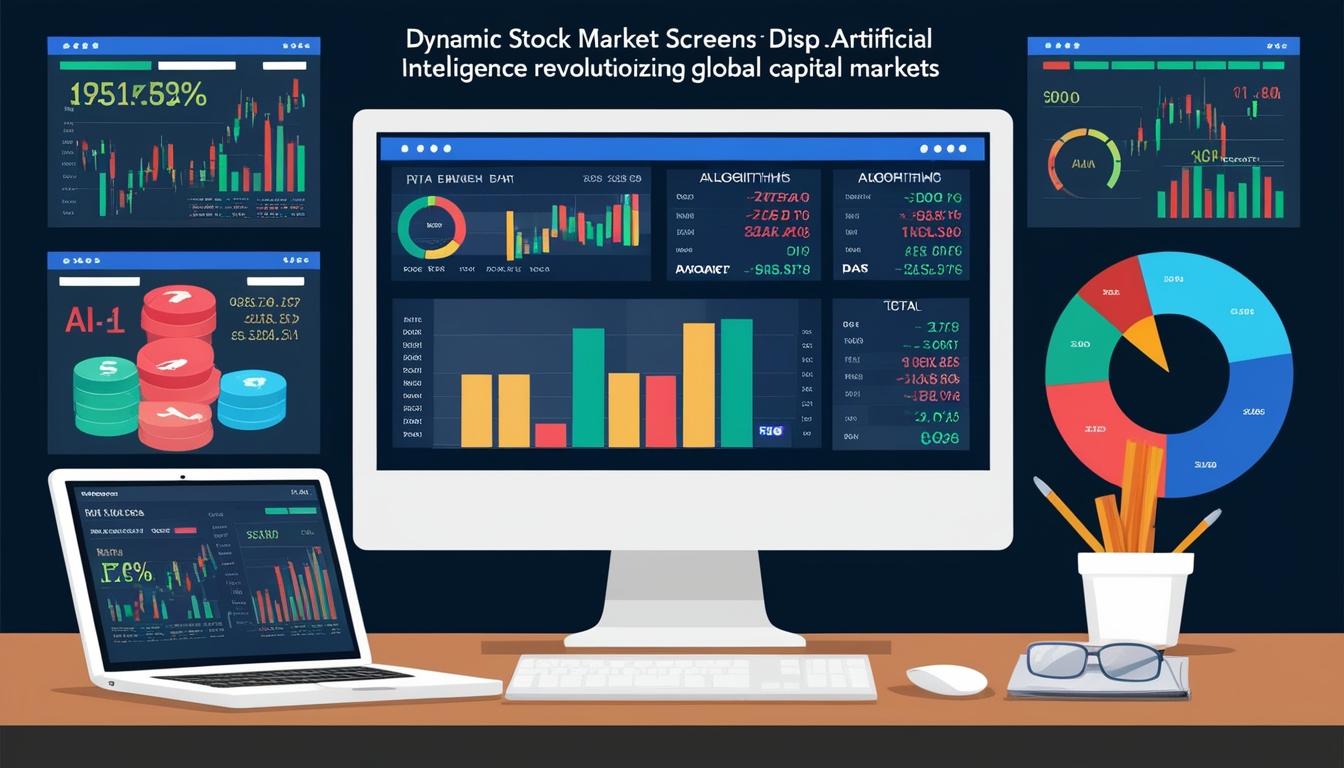
Artificial Intelligence Revolutionises Global Capital Markets
Artificial Intelligence (AI) has made significant strides in transforming the landscape of capital markets, enhancing trading efficiency and liquidity. From predictive analytics to sophisticated algorithmic trading, AI is not only changing the operational framework of financial markets but also facilitating faster and more accurate decision-making processes.
Machine Learning and Predictive Analytics in Market Forecasting
Machine learning (ML) technology is at the forefront, utilising vast datasets to forecast market trends and prices. These algorithms, through techniques such as supervised and unsupervised learning, are adept at recognising patterns, thus providing predictive insights into potential market changes. By continuously learning from new data inputs, these models progressively refine their accuracy, offering a powerful tool for traders who seek to anticipate shifts in the financial markets.
Harnessing AI for Natural Language Processing
Natural Language Processing (NLP) is another area where AI has shown utility, enabling machines to interpret and process human language. In finance, NLP is deployed to analyse a wide array of documents including news articles, financial reports, and social media, decoding market sentiment that often influences trading decisions.
The Rise of Algorithmic Trading Systems
Algorithmic trading, powered by AI, executes trades automatically based on pre-defined criteria, offering the advantage of executing trades at a speed and frequency beyond human capabilities. These systems leverage real-time data to adapt strategies dynamically, ensuring effective trading that captures opportunities even in volatile conditions.
Improving Trading Efficiency with High-Frequency Trading
AI underpins high-frequency trading (HFT), enabling swift processing of numerous orders with minimal latency. This capability allows traders to exploit minute price discrepancies, although it does raise concerns regarding market stability and the risk of flash crashes.
AI-Driven Trading Strategies and Risk Management
Advanced AI algorithms optimise various trading strategies like trend-following, mean reversion, and statistical arbitrage by constantly analysing data and adjusting models in response to market changes. AI also plays a vital role in managing trading risks, utilising predictive models to evaluate risk factors and simulate potential scenarios. Through this, traders can develop more robust portfolios tailored to specific risk tolerances and objectives.
AI's Contribution to Market Liquidity Enhancement
AI models predict liquidity by analysing trading volumes and market depth, offering foresight into liquidity conditions that help in planning trades more effectively. Furthermore, market makers utilise AI to provide liquidity by maintaining competitive buy and sell prices, thus narrowing the bid-ask spreads and enhancing market efficiency.
Understanding and Addressing the Challenges
Despite these advancements, AI in trading faces challenges related to data quality and algorithmic bias. The reliability of AI models depends heavily on data accuracy, and flawed data can significantly impair trade decisions. Furthermore, there is an ongoing need to address algorithmic bias, which can lead to unfair trading practices, ensuring fairness and transparency in AI deployment.
Regulatory and ethical considerations also play a critical role, with authorities concerned about potential market manipulation and systemic risks associated with AI-driven trading.
Future of AI in Capital Markets
The future looks promising with further developments in AI technologies such as deep learning and reinforcement learning, which are set to enhance predictions and trading strategies. Integration with technologies like blockchain is expected to improve transparency and security, thereby revolutionising market operations.
As AI continues to evolve, its influence on global capital markets is anticipated to expand, bringing about increased efficiency, innovation, and potentially reshaping the entire trading ecosystem.
Altcoin Trends and Prospects in 2024
The cryptocurrency market remains a dynamic field, with altcoins gaining substantial traction due to their unique features and innovation potential. As 2024 progresses, altcoins like Ethereum, Ripple, Shiba Inu, Dogecoin, and BONK Coin are making waves for various reasons.
Ethereum: Known for its robust support for decentralised applications and smart contracts, Ethereum is a significant player in the DeFi sector, with a substantial market capitalisation.
Ripple: With its fast, low-cost transaction system, Ripple has been widely adopted by financial institutions for international transfers, leveraging its native token XRP.
Shiba Inu: Originating as a meme coin, Shiba Inu has gained popularity due to its community backing and presence in the Ethereum blockchain.
Dogecoin: Initially conceived as a joke, Dogecoin has grown significantly, supported by influential personalities and maintained its place as a leading altcoin.
BONK Coin: As the first dog-themed coin on the Solana blockchain, BONK aims to boost decentralized exchange liquidity, showing resilience and potential in the market.
Conclusion
AI is redefining capital markets by improving trading dynamism and liquidity. Its application, along with advancements in altcoins, signifies a progressive shift in both the traditional financial sectors and emerging digital currencies. As these technologies continue to mature, they promise to offer novel opportunities and transform the future financial landscape.
Source: Noah Wire Services