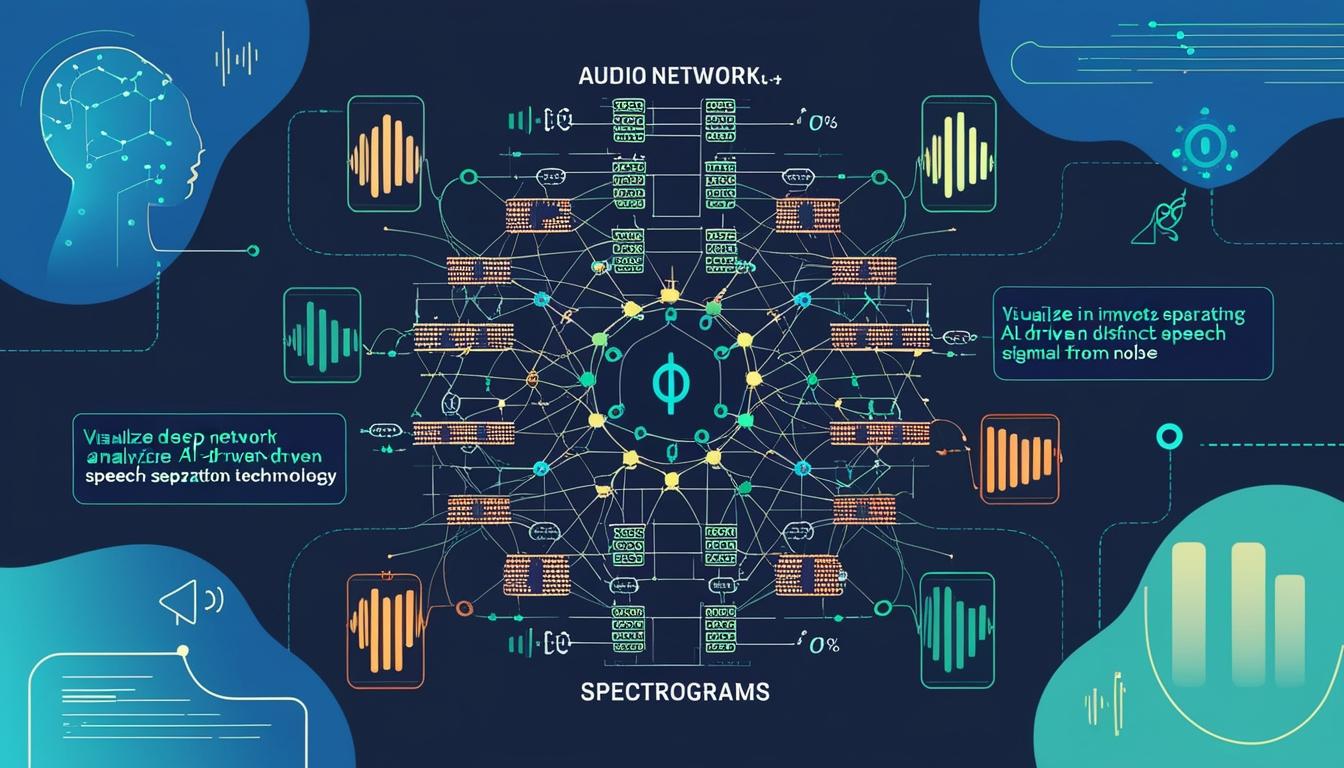
New AI Technique Unveiled for Enhanced Speech Separation Capabilities
In the evolving field of artificial intelligence, a new speech separation method has emerged, aiming to resolve longstanding challenges in separating speech signals from noise—a method introduced as Example 48 within a series exploring innovative speech signal processing techniques. Traditional methods have often stumbled when tasked with distinguishing between different speakers within the same audio class. Example 48 attempts to redefine these boundaries by employing deep neural networks (DNN) to improve the clarity and functionality of speech separation systems.
Understanding the Technical Framework
The novel method is characterised by a series of processes designed to isolate distinct speech sources from a mixed signal. Specifically, it involves the transformation of complex audio inputs into spectrograms via a short-time Fourier transform. These spectrograms are further analysed using DNN to generate embedding vectors that identify distinct speech features from mixed signals. Unlike previous methods, this technique does not require pre-knowledge of the number of speakers, nor does it need training data from the multiple constituent sources, making it a significant progressive step in audio signal processing.
Developmental Phases and Issues
This burgeoning AI-powered approach, however, experienced a setback in the early stage of patent claim eligibility assessments. Initial evaluations labelled the Claim 1 method ineligible, indicating that the claim, while innovative in process, failed to substantiate its real-world applicability or a technological improvement in practical terms. Such issues typically originate from the integration of abstract mathematical operations without imposing real-world constraints or pragmatic uses.
Further Refinements and Success in Subsequent Claims
Progressing from this, the developers introduced amendments in subsequent claims, notably Claim 2, which expands the method to include the creation of a new speech signal, effectively separating undesired audio. This claim was evaluated and deemed eligible, signifying a recognised technical advancement. It highlights additional method steps such as partitioning embedding vectors into distinct clusters and synthesising these into separate speech waveforms, culminating in an improved mixed speech signal devoid of unwanted audio elements.
Claim 3 further extends these concepts onto a non-transitory computer-readable storage medium, asserting the capacity to translate separated speech into text. This claim too was granted eligibility, given its practical application in converting audio signals into textual data—useful for tasks like transcription.
Performance and Potential Applications
These advancements reflect significant improvements in handling complex audio environments, particularly in enhancing systems involved in real-time speech recognition and transcription. By resolving key issues such as inter-speaker variability and differentiating between similar audio classes, the method promises improvements in transcription accuracy—a crucial enhancement for industries reliant on clear and precise audio-to-text conversions.
Conclusion
The introduction of this advanced speech separation method illustrates ongoing developments in AI's capability to solve complex audio processing challenges. While initial steps faced hurdles in claim eligibility, refinements in methodology and clear illustrations of practical applications eventually positioned this approach as a robust solution poised to make a substantive impact across various fields requiring detailed and accurate audio analysis.
Source: Noah Wire Services